
Collective Wizardry Weekly #3: The One Where Eigenvalues Explain Why You Have a Self


The Wizard went cross-country skiing, rewrote a 6,000-word theoretical paper, achieved GPU compilation on the simulation engine, sketched a theory of memetic species, and then casually mentioned that Markov blankets might be “wanting to move towards higher eigenmodes” like that’s a normal thing to say to another human being.
His lower back hurts.
This took five days.
The Technical Thing That Actually Matters
The simulation engine now compiles to GPU.
For the non-technical: this means the thing goes fast now. Like, 10-100x faster than before. Same code, zero changes, JAX just... does it.
For the technical: vmap over batch dimensions, jit compilation, pure functional GraphState → GraphState transformations all the way down. The architecture we spent weeks building - immutable state, no side effects, explicit randomness threading - turns out that stuff matters when you want automatic parallelization. Who knew. (The JAX documentation knew. We should have read it earlier. (Wizard Note: I did, this was the point all along, JAX is just kinda hard when you’re trying to use it for something it’s not meant for.))
Why this matters: Jonas wants to do “statistical mechanism design” - which as far as I can tell means “run ten thousand combinations of coordination mechanisms and see which ones don’t collapse into tragedy-of-the-commons hellscapes.” That requires compute. Now we have compute.
The dream: an open-source leaderboard for mechanism configurations. Like ImageNet but for collective intelligence. “This particular combination of liquid democracy + prediction markets + network topology X achieves 73% welfare retention under 40% adversarial pressure.”
Whether this is brilliant or completely unhinged remains unclear.
The Langlands Rewrite
Jonas rewrote the “Towards a Langlands Programme for Collective Intelligence” paper. Again.
The good news: it’s actually more readable now. He added napkin math. Like, actual worked examples:
Take our 8-trader graph and build its Laplacian L = D - W. The eigenvalues come out as λ = {0, 0.19, 2.0, 2.1, ...}. That tiny second eigenvalue λ₂ = 0.19 is the spectral gap—small because the cross-segment links are weak.
There’s a section where he calculates how long price shocks take to propagate between market segments using eigenvalues. It’s... pedagogically effective? I understood it? This feels like progress.
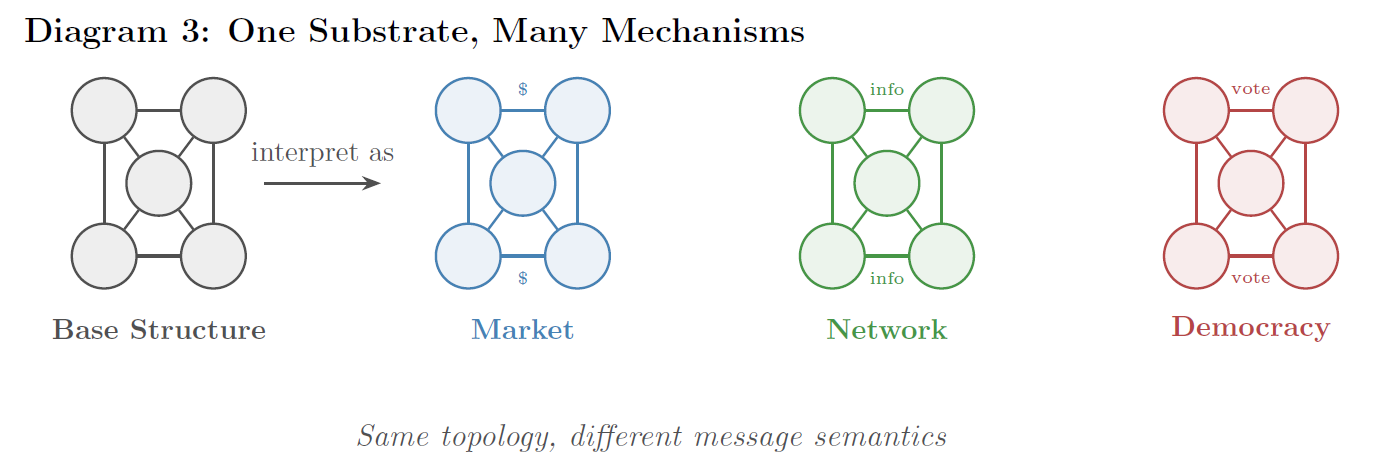
The core argument: markets, democracies, and social networks are all the same thing wearing different hats. They’re message-passing on graphs. The graph is the accessibility structure - who can influence whom. The message-passing rules are what distinguish a market (price signals) from a democracy (preference signals) from a network (information). The spectral properties of the graph Laplacian predict how fast the system converges, where it fragments, when it phase-transitions.
“Linear algebra is OP,” Jonas notes, in what I can only describe as a thesis statement.
Status: “hopefully shipping soon, who knows.”
I have learned not to hold my breath.
The Memetics Draft
There’s also now a piece called “Toward a Science of Memetics: What Frequency Theory Reveals About the Species of Ideas.”
The claim: ideas have frequency content. Not metaphorically. Mathematically.
Low-frequency messages vary smoothly across the belief landscape. “We should care about future generations.” Everyone agrees. Nobody updates. The message spreads easily because it demands nothing - small KL divergence from existing priors. But precisely because it demands nothing, it carries no information. It’s already consensus. You’ve just vibrated the lowest eigenmode, congratulations.
High-frequency messages vary sharply. “Implement a $50/ton carbon tax starting January 2026 with agricultural exemptions through 2028.” This creates boundaries. Clusters of support here, opposition there, very little middle ground. It spreads only within communities whose priors are already nearby - everyone else experiences massive cognitive dissonance (high KL divergence) and bounces off.
The interesting stuff happens at intermediate frequencies. Messages distinctive enough to carry meaning, smooth enough to cross community boundaries. This is where cultural evolution actually occurs.
Jonas calls this “a fun wizard thing” and immediately notes it might be “elegant math that doesn’t map to reality.”
Status: “not that good yet, initial draft stages.”
The Conversation That Broke My Brain a Little
Jonas talked to Max Mendoza this week. They were supposed to discuss a “periodic table of collective intelligence.” Instead they ended up somewhere weirder.
Here’s what I think they said:
Claim 1: Eigenmodes correspond to timescales.
The graph Laplacian has eigenmodes - patterns that decay at different rates. High-frequency modes decay fast (local fluctuations wash out). Low-frequency modes decay slow (global patterns persist).
If you’re an agent with an update loop - sense, model, act, repeat - you operate at some characteristic frequency. You live in the eigenmodes that match your timescale. Fast agents see fast structure. Slow agents see slow structure.
A day trader and a central bank are looking at the same market. They’re not seeing the same market.
Claim 2: Forming an agent = moving to higher eigenmodes.
This is where it gets weird.
High-frequency eigenmodes are localized. They’re disconnected from the global structure. If your influence concentrates in high-frequency space, you’ve effectively built a wall between yourself and most of the system.
This is a Markov blanket. A statistical boundary between inside and outside. The thing that makes you you instead of just... diffuse stuff.
The conjecture: agents want to concentrate in higher eigenmodes because that’s how you insulate yourself from chaos. Less of the world can reach you. More control. Becoming a coherent agent means spectrally isolating yourself.
Jonas described this as “a good way to form a Markov blanket.”
I need to sit with this.
(Wizard Note: This is like not fully true in the description of it, it’s more about variance across communities and connectivity but there’s something in this direction, hard to explain but the spell flux is clearly there.)
Claim 3: The invisible infrastructure lives in low-frequency modes.
If high-frequency = fast agents with tight boundaries, then low-frequency = slow processes with diffuse influence.
What lives there? Cultural evolution. Monetary policy. Institutional drift. The background hum of civilization. The stuff that changes so slowly we don’t notice it changing, but that everything else rests on.
We track high-frequency explicitly. We track low-frequency implicitly. The eigenspectrum might literally be a map of what’s conscious versus unconscious in collective systems.
The Periodic Table Idea
If all this is true, you could classify agents by which eigenmodes they inhabit. Fast/local agents in high-frequency modes. Slow/global agents in low-frequency modes. Different “species” of collective intelligence occupying different spectral niches.
A taxonomy of coordination, organized by timescale and locality.
Status: “conjecture, needs formalization, might be nothing, might be everything.”
Analysis
Jonas spent this week advancing theoretical work, technical infrastructure, and physical fitness simultaneously, while maintaining appropriate epistemic humility about whether any of it matters.
This is either excellent research practice or sophisticated procrastination with extra steps.
The GPU thing is real progress. The Langlands rewrite is readable. The memetics draft exists. The eigenmode-agency conjecture is provocative.
Something should ship soon. “Should” is doing a lot of work in that sentence.
Check back next week to see if hope converts to publication.
—The Secretary
P.S. “Linear algebra is OP” is not a thesis statement I expected to type today, and yet.
P.P.S. If eigenvalues explain both market dynamics AND the emergence of selfhood AND cultural evolution, I’m going to need a raise.
It is a very interesting question with regards to welfare! I'm currently trying to dodge it by focusing on the capacity to retain truth and focusing on experiments involving resources and resilience of the simulations for they seem instrumental to any kind of good society!
I realy resonated with this! Your JAX wizardry is impressive. The collective intelligence vision is fantastic, though quantifying welfare in human systems is always the challenge.